
★★★★★
4.9 · 12,800+ happy customers
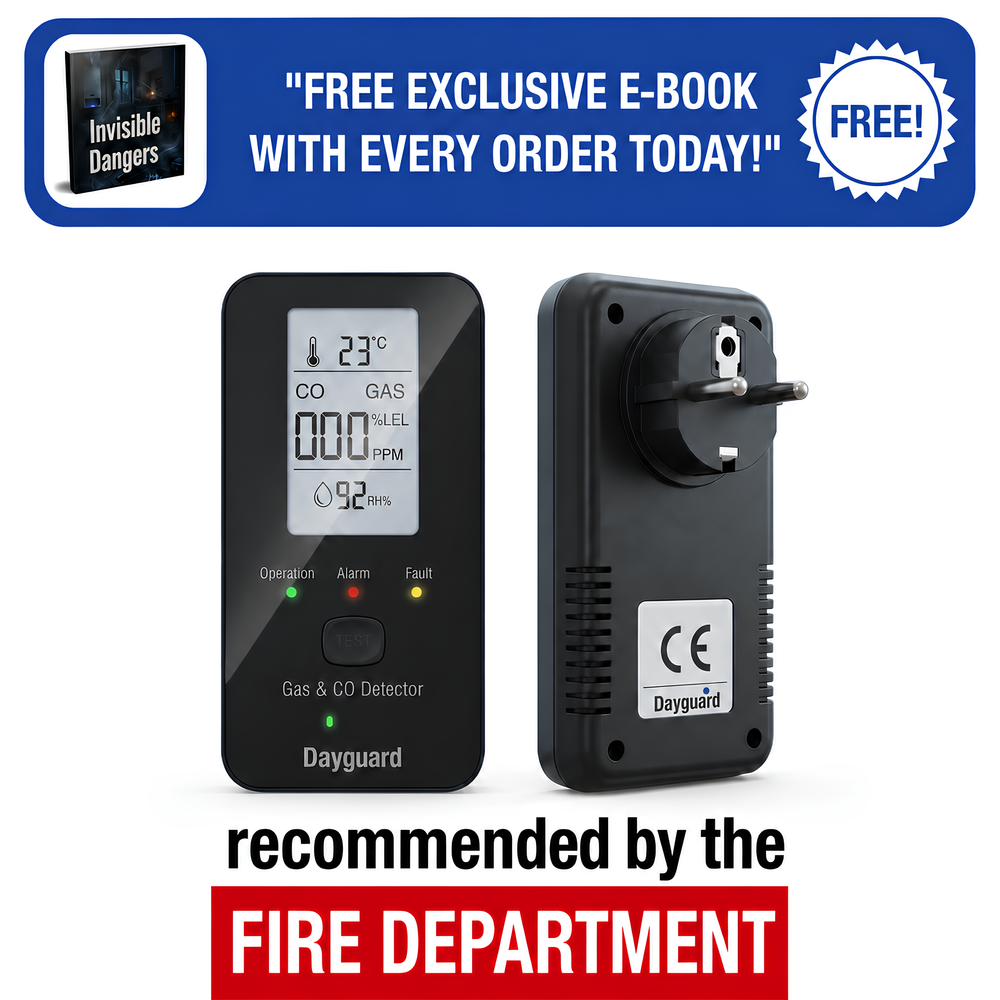
Dayguard X4 - 4 in 1 CO Detector
€59,95€99,95−40%
Incl. VAT · shipping calculated at checkout · Free shipping over €80
- Detects 4 threats: carbon monoxide, natural gas, propane/butane & humidity
- Real-time display with exact PPM readings — no guessing, no blinking lights
- Early warning from 30 PPM — reacts before standard detectors even wake up
- Ready in 2 minutes — plug it in, done. No tools, no mounting
100-day money-back guarantee
Low stock — selling fast
Free shipping over €80
€59,95Dayguard X4 - 4 in 1 CO D...
12,800+ households protect their homes with Carbon
Rated 4.9/5 · Ships from Germany · 100-day returns
SMSMSMTSPHAWCB
Know the threat
What is carbon monoxide — and why it concerns almost every home
Carbon monoxide (CO) forms wherever fuels like gas, oil, wood or coal don't burn completely. The dangerous part: it's invisible, odourless, and blocks your body's ability to absorb oxygen — you won't notice it until it's too late. Because CO binds to red blood cells around 300 times more strongly than oxygen, even small amounts are enough: first symptoms can appear at levels as low as 35 ppm. For children, pregnant women, older adults and pets, the danger is even greater.
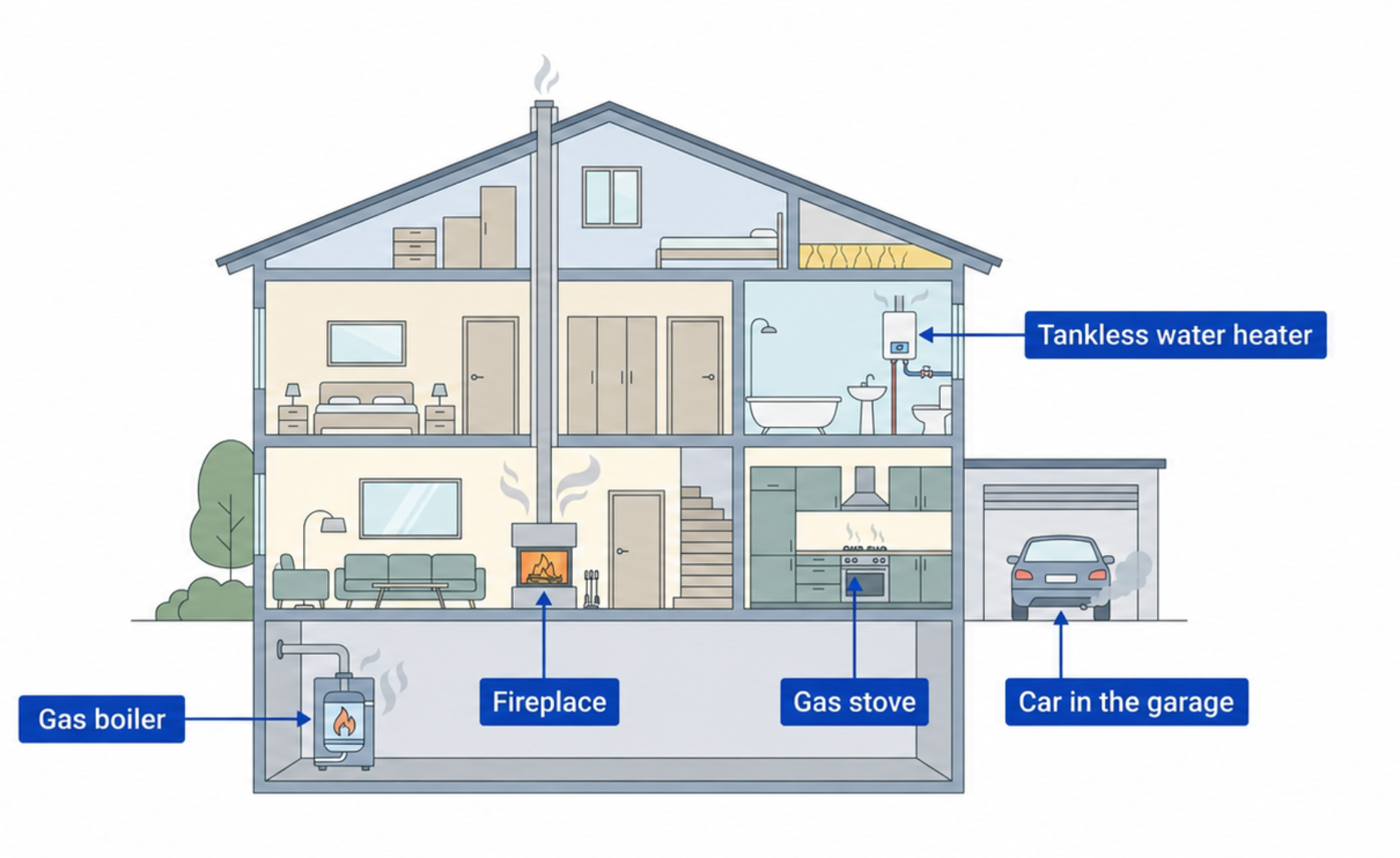
Where carbon monoxide forms
Who — and where — is most at risk
Homes with a basement furnace
Apartments with a gas heater
Tightly sealed new builds
RVs & travel trailers
Boats & camping
Workshops & hobby rooms
Families with young kids
Bedrooms next to the furnace
In short: anywhere something burns, carbon monoxide can form. That's why an alarm that warns you early makes sense for nearly every home.
Why Carbon
A detector that thinks ahead — instead of just screaming
Most detectors only warn you when it's almost too late. Carbon shows you the danger in numbers, long before it turns critical.
4-in-1 sensor
Carbon monoxide, natural gas, propane/butane and humidity — one device instead of four.
Clear-number display
Exact PPM readings in real time — you see the danger instead of guessing it.
Early warning from 30 PPM
Alerts earlier than standard detectors — you gain the minutes that matter.
2-minute setup
Plug it in, done. No drilling, no tools, no app required.
Place it right
How many detectors does your home need?
Carbon monoxide travels with the air in your home. A single detector in the hallway is rarely enough. Rule of thumb: one Carbon per floor, plus one in every room with a potential source.
- Bedroom — you're most vulnerable while you sleep
- Near the heat source — gas boiler, wood stove, water heater
- Kitchen — gas stove and open flames
- RV, boat or workshop — small spaces, high risk
Reading the display
What Carbon shows you at a glance
PPM
Carbon monoxide
Concentration in the air. Carbon warns from 30.
%LEL
Natural/LP gas
Share of combustible gases — early warning before explosion risk.
%rH
Humidity
Healthy range is 40–60%. Helps prevent mold.
°C
Temperature
Room climate at a glance — great for the bedroom.
The invisible threat
Why you'll never notice carbon monoxide on your own
CO has no color, no smell, no taste. It's produced by any incomplete combustion — heating, fireplace, gas stove, grill, or a car in the garage.
In your body it binds to your blood roughly 200× stronger than oxygen. The first symptoms — headache, fatigue, nausea — feel like a common cold. That's exactly what makes CO so dangerous: you lie down instead of airing out.
Who's most at risk
If any of these apply to you, Carbon belongs in your home
Gas heating or a gas boiler in your home
Wood, pellet or open fireplace
Gas stove or instant water heater
Well-insulated new build with little airflow
RV, camper or boat
Workshop, hobby room or attached garage
Bedrooms close to the heating system
Household with kids, seniors or pets
Older building with aging heating tech
Who — and where — is most at risk
Homes with a basement furnace
Apartments with a gas heater
Tightly sealed new builds
RVs & travel trailers
Boats & camping
Workshops & hobby rooms
Families with young kids
Bedrooms next to the furnace
In short: anywhere something burns, carbon monoxide can form. That's why an alarm that warns you early makes sense for nearly every home.
Carbon vs. standard detectors
The difference that decides over minutes
| Feature | Carbon | Standard detectors |
|---|---|---|
| Warning threshold | from 30 PPM | often only at 50–70 PPM |
| Detects multiple gases | ✓ CO, natural gas, propane | ✕ CO only |
| Exact readings | ✓ Live PPM | ✕ blinking light/sound only |
| Humidity & temperature | ✓ | ✕ |
| Installation | Plug in, 2 min. | Drilling & batteries |
| Power | Continuous via outlet | Battery (can die) |
Why this matters
Carbon monoxide is underestimated
Smoke alarms are mandatory — CO detectors are not. Yet the danger strikes exactly where a smoke alarm notices nothing.
3,000+
CO poisonings per year in Germany alone
Hundreds
of deaths every year — many of them preventable
In their sleep
is when it hits most victims — unnoticed
Figures for illustration — verify with an official source before going live.
What happens in your body
This is the window where Carbon warns you — standard detectors stay silent
30PPM
First signs
Headache, fatigue, mild nausea. Carbon already sounds the alert here.
50PPM
The strain increases
Dizziness, trouble concentrating, racing heart. Your body is under real stress.
70PPM
Only now do many detectors react
Critical range — precious time has already passed.
What customers say
Why families trust Carbon
★★★★★
“Finally I see real numbers instead of a little green light. Setup took less than two minutes.”
SM
Sabine M.Verified buyer
★★★★★
“I had no idea my gas heating could be a risk. Now I simply sleep better.”
TS
Thomas S.Verified buyer
★★★★★
“We got one for our RV. Small, reliable, and you can read the value instantly. Highly recommend.”
AW
Andreas W.Verified buyer
Sample reviews (placeholders) — replace with real reviews before launch.
“On duty I see again and again how much difference a few early minutes make. A detector that shows low readings buys your family exactly the time that counts.”Placeholder — replace with a real, consenting person
Common questions
Everything you want to know before you buy
Which gases does Carbon detect?
Carbon measures carbon monoxide (CO), natural gas and propane/butane, plus humidity and temperature — four readings in one device.
How many detectors do I need?
Rule of thumb: one per floor, plus one in each room with a potential source (heating, kitchen, bedroom). For most homes, 2–3 units are ideal.
Do I need to install or mount anything?
No. Plug Carbon in and it's ready. No drilling, no tools, no app.
Why from 30 PPM and not later?
Many standard detectors only alarm at 50–70 PPM. Carbon shows a reading from 30 PPM — you gain precious time to air out and act.
How long does the sensor last?
The sensor is built for years of continuous use. See the product description for lifespan and warranty details.
Does it work during a power outage?
Carbon runs on continuous power via the outlet. For outage protection, consider a model with battery backup — just ask us.
How fast is shipping, and can I return it?
Shipped from Germany. You have 100 days — if Carbon isn't for you, you get your money back.
100days
100-Day Money-Back Guarantee
Test Carbon for 100 days, no rush. Not convinced? Send us a message and we'll refund the full purchase price. No questions asked.
Safety you can't see — but feel
Don't wait for the emergency. Protect your home with Carbon today.